
How to size a conical vacuum dryer: material inputs, heat-load and jacket-area calculation, fill ratio, vacuum duty, and export compliance.
A conical vacuum dryer is a jacketed, rotating double-cone vessel that dries heat-sensitive powders, granules, and filter cakes under vacuum, typically in batch mode with solvent recovery. Size it from the material first, not from a vessel volume: establish the batch mass, wet bulk density, and initial and final moisture, then confirm that the jacket heat-transfer area available at the candidate size still delivers the evaporation rate your cycle time demands.
Choosing a vessel volume before running the heat-load calculation is the most common sizing error in this equipment class, and it usually surfaces late, as a dryer that cannot reach the target moisture inside the production window.
What a Conical Vacuum Dryer Does Best
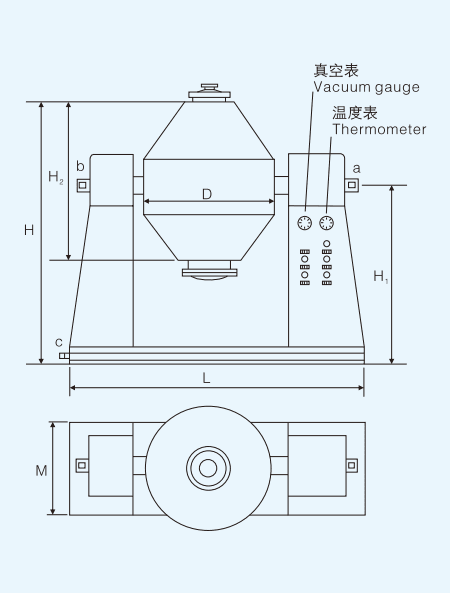
The geometry is the point. A double-cone vessel rotates slowly while the jacket heats the shell and the vacuum system pulls vapour off the bed. Because there is no internal agitator shaft and no gas sweep through the product, the material tumbles in a gentle, low-shear motion. That behaviour matters most for three material classes:
The trade-off is mechanical. A rotating vessel carries heat only through its jacket, and jacket area grows with the square of vessel dimensions while volume grows with the cube. That surface-to-volume ratio is why conical vacuum dryers are excellent at moderate batch sizes and become heat-transfer-limited as they scale up. Recognising that ceiling early is the core engineering judgement in this dryer family.
- Heat-sensitive solids where a rising product temperature degrades the active ingredient.
- Solvent-wet cakes where the recovered solvent has to be condensed rather than vented.
- Free-flowing powders and granules that high-shear agitation would damage or turn into a dust hazard.
Start With Five Material Inputs, Not a Vessel Volume
Sizing begins with a bench-scale material profile. Five inputs decide everything downstream: batch mass in kilograms of wet feed, determined by the upstream process; wet bulk density, measured on the actual cake rather than taken from a dry powder datasheet; initial and final moisture on a wet basis; the identity of the liquid, since a solvent has its own latent heat, boiling curve, and flammability class; and the target cycle time in hours, which is the constraint that most often makes a job infeasible.
Two cautions apply. First, moisture expressed on a wet basis and on a dry basis differ substantially, and mixing the two conventions is a routine source of under-sized equipment. Second, if the feed arrives as a paste rather than a free-flowing solid, verify before sizing that it will actually tumble inside a rotating cone instead of compacting into a static mass. That behaviour belongs in a pilot trial, not a spreadsheet.
Work Through the Heat-Load Calculation
The evaporation rate becomes a heat load through two terms: the latent heat needed to vaporise the liquid, and the sensible heat needed to raise the feed and its residual solids to the operating temperature. Express the total as a power figure: mass of liquid per hour multiplied by latent heat, plus feed mass per hour multiplied by specific heat and temperature rise, converted to consistent units. Add margin for jacket losses to ambient and for the heat carried away by vapour leaving the vessel.
Two properties of vacuum operation shift the numbers in your favour. The boiling point falls, so at reduced pressure the liquid boils well below its atmospheric boiling point and the temperature-rise term shrinks. This is the mechanism that protects heat-sensitive products. The vapour is also denser and lower in volume, which means the volumetric load on the vacuum pump and condenser is set by the operating pressure, not by atmospheric conditions.
What this calculation cannot supply is the overall heat-transfer coefficient for your specific material. A dry powder, a sticky paste, and an agglomerating granule present completely different contact behaviour against the heated shell, and no catalogue figure substitutes for a pilot test on your own feed. Treat that coefficient as an output of testing rather than an input you look up.
Convert Heat Load Into Required Jacket Area
Heat load and jacket area are linked by the standard conduction relationship: heat transferred equals the overall coefficient multiplied by the jacket area multiplied by the temperature difference between the jacket medium and the product bed. Solve it for area and you have your first hard specification: required area equals heat load divided by the product of the coefficient and the available temperature difference.
Three practical constraints shape the result. The temperature difference is bounded by the product, because a material that degrades above a threshold cannot simply be exposed to a hotter jacket. The coefficient degrades as the batch dries, since late in the cycle the feed is dry and contact with the shell worsens. And the area available is a function of vessel size rather than a free variable, so once you know the area you need, you compare it against what a candidate size actually provides.
That last point is why the conical geometry has a natural ceiling. When the required area exceeds what a rotating cone can offer, dryers that place heat-transfer surface inside the product deliver far more area per unit of vessel volume. Reaching that crossover is the signal to change dryer type, not to add more vacuum.
Set Working Volume, Fill Ratio and Freeboard
Only now does vessel volume come into play, and it answers a different question: how much material can physically be held and tumbled. Working volume is the batch bulk volume, that is, batch mass divided by wet bulk density, not the nominal vessel volume. The gap between the two is the freeboard, and it has to absorb two things at once: the expanded, aerated bed thrown up by rotation, and the vapour space that lets the vacuum system draw vapour off without entraining fines toward the filter.
Fill ratio, meaning working volume as a proportion of total vessel volume, is therefore a configuration decision with a real trade-off:
A rotationally agitated conical dryer additionally needs enough free bed depth for the tumbling action to renew material against the heated shell, so ratios that work in a static tray dryer will not transfer here. Set the fill ratio with your supplier against a pilot batch, because it depends on the angle of repose and the agglomeration tendency of the specific material, which are the two properties least likely to be captured accurately in a specification sheet.
Fill Ratio Trade-off
| Fill ratio | Consequence |
|---|---|
| Too low | Poor volumetric utilisation; more vessel than the batch needs; longer cycle per kilogram processed |
| Balanced | Bed tumbles freely, freeboard absorbs expansion, vapour path stays clear, filter loading stays manageable |
| Too high | Reduced tumbling; fines entrainment toward the vacuum filter; carryover into the condenser |
Match the Vacuum and Condenser System to the Solvent
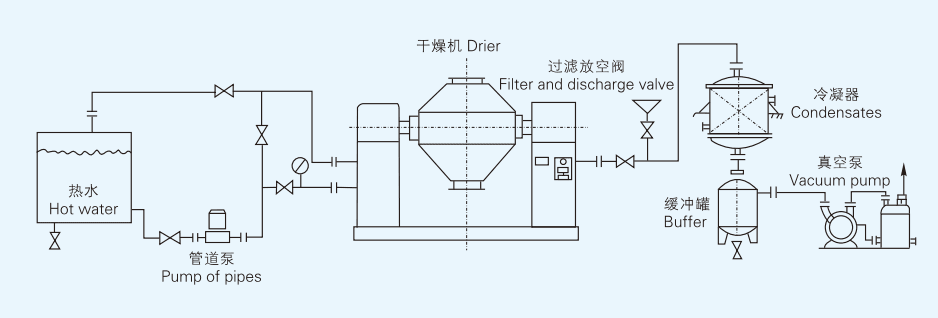
The vacuum system is not an accessory bolted onto a sized dryer; it is half the process. Two duties have to be met simultaneously. Evacuation duty means pulling the vessel down to operating pressure at the start of each batch and holding it against the in-leakage of a rotating, sealed vessel. Vapour handling duty means removing the vapour generated at the calculated evaporation rate, at the operating pressure, without letting the pressure rise.
These are different requirements, and a pump selected on evacuation alone will be undersized for sustained vapour load. Size the pump and condenser on the vapour duty at the peak evaporation rate, then add margin for leaks through shaft seals and valve packings that develop as the equipment ages. The condenser is sized on the same evaporation rate, with a coolant temperature low enough to condense the solvent at the lowest pressure the pump reaches.
Choose the coolant temperature against the actual condensing curve of the solvent in question rather than a generic one, and remember that a colder condenser shifts duty to the refrigeration system instead of eliminating it. For solvent-wet feeds this is also where explosion protection enters the sizing discussion, because a system that recovers solvent efficiently and a system that is safe to operate with solvent are designed together.
Materials of Construction and Compliance for Export
Material selection follows the feed chemistry and the cleaning regime rather than the price list. Austenitic stainless steel such as 316L covers the majority of chemical and pharmaceutical duties where the feed is neutral to mildly corrosive and surfaces must be cleanable. Higher-alloy and nickel-based materials become necessary for halide-bearing or strongly acidic feedstocks, where chloride stress-corrosion cracking in 316L is a genuine risk. Surface finish matters as much as alloy grade for pharmaceutical duty, because contact surfaces need a finish that supports validated cleaning rather than harbouring residue.
If the finished product is destined for the European market, three requirements drive the documentation package:
For pharmaceutical service, add a cleaning validation package aligned to cGMP expectations and, for sterile or high-potency products, containment provisions. Discuss these requirements early, because retrofitting certification onto a vessel after fabrication is far more expensive than specifying it up front.
- ATEX: equipment used in potentially explosive atmospheres falls under Directive 2014/34/EU. A vessel wetted with a flammable solvent makes the interior a classified zone, which shapes seal design, instrumentation, and inerting.
- Pressure vessel construction: jacketed vessels are designed and stamped to a recognised construction code, ASME BPVC Section VIII for North American projects or the PED for the EU. Ask for the design calculations and the stamp, not just a claim of compliance.
- Machinery safety: placing the equipment on the EU market is governed by Machinery Regulation (EU) 2023/1230, which replaces the earlier Machinery Directive and carries the CE marking obligation.
Conical vs. Rake vs. Hollow Blade: Choosing the Right Design
Once the sizing calculation is complete, the design choice usually falls out of the numbers. The table below compares the three vacuum dryer families most often evaluated side by side for the same batch.
The practical reading: choose the conical design when the feed flows, the batch is moderate, and product protection is the priority. Move to rake or hollow blade geometry when the required jacket area exceeds what a cone can supply, or when the feed is a paste or cake that will not tumble. Where a continuous duty is required rather than batch, the paddle-based designs are the only ones in this family that support it. Whatever the geometry, the sizing chain stays the same: material profile, evaporation rate, heat load, required area, then vessel size and fill ratio, then vacuum and condenser duty.
Vacuum Dryer Comparison
| Criterion | Conical (double-cone) | Vacuum rake | Hollow blade |
|---|---|---|---|
| Heat input | Jacket only | Jacket only (agitator unheated) | Jacket plus heated blades |
| Heat-transfer area per unit volume | Lowest | Moderate to high | Highest |
| Material motion | Gentle tumbling, low shear | Rake agitation, moderate shear | Paddle agitation, shearing |
| Best feed form | Free-flowing powders and granules | Pastes and sticky cakes | Filter cakes, sludges, pastes |
| Product temperature control | Excellent, no hot internal surface | Good | Good, with closer wall contact |
| Discharge | Rotation and cone angle | Rake conveys to end discharge | Paddle conveys to outlet |
| Solvent recovery fit | Very good | Very good | Very good |
| Main scaling limit | Jacket area available | Shaft seal and torque | Blade wear and build-up |
| Continuous operation | Batch only | Batch or semi-continuous | Continuous-capable |
Where to Go Next
The sizing chain above is the same for every batch vacuum dryer, and it is worth running through before any quotation is compared, because two suppliers quoting the same nominal vessel volume can be offering very different heat-transfer capability. If the calculation points toward more heat-transfer surface than a rotating cone can provide, compare it against the agitated alternatives. If it points toward a solvent-wet duty, size the condenser and vacuum system on the same evaporation rate you used for the jacket, and decide on the explosion protection concept at the same time.
Frequently Asked Questions
- How do I calculate the right conical vacuum dryer size for my batch?
- Work in this order: batch mass and wet bulk density give the working volume; initial and final moisture give the liquid to evaporate; the target cycle time gives the evaporation rate; the evaporation rate gives the heat load; and the heat load divided by the coefficient and available temperature difference gives the required jacket area. Compare that area against what a candidate vessel actually provides before fixing a size.
- What fill ratio should I specify?
- Enough working volume for the batch with freeboard above it for bed expansion and for a clear vapour path to the filter. The exact ratio depends on the angle of repose and agglomeration behaviour of the material, so it is best fixed during a pilot batch on your own feed rather than assumed from a similar application.
- Can a conical vacuum dryer handle solvent-wet material safely?
- Yes, provided the equipment is designed for it from the start: closed-loop operation, inerting where required, an ATEX-rated electrical package, appropriate seal design, and a condenser sized to the peak vapour rate. Retrofitting explosion protection onto a vessel designed without it is neither cheap nor straightforward.
- What is the difference between a conical vacuum dryer and a vacuum rake dryer?
- Geometry and heat transfer. The conical dryer rotates the whole jacketed vessel and has no internal agitator, giving very gentle handling but limiting heat input to the jacket. The rake dryer holds the shell stationary and sweeps the batch with scraper blades against the heated jacket wall. The agitator itself is not heated, so the jacket remains the only heat-transfer surface, but continuous scraping keeps that surface productive and lets the machine handle pastes and sticky cakes that would not tumble.
- How long does a drying cycle take?
- Cycle time is an output of the sizing calculation, not a fixed figure. It depends on how much liquid must be removed, how much jacket area is available, the permissible product temperature, the applied vacuum, and how the heat-transfer coefficient decays as the batch dries. Specifying a cycle time first and sizing to it is the correct approach.
- Can I dry heat-sensitive material in a conical vacuum dryer?
- This is the application the design suits best. Operating under vacuum lowers the boiling point, so the liquid vaporises at a temperature well below its atmospheric boiling point and the product never has to reach a level that would degrade it. There is no hot internal agitator surface either, which removes a common local overheating point.
- What certifications should I require from a supplier?
- For EU export, ask for the ATEX documentation against Directive 2014/34/EU, the pressure-vessel design calculations and stamp to the applicable construction code, and the CE conformity documentation under Machinery Regulation (EU) 2023/1230. For pharmaceutical service, request the cleaning validation package and surface-finish records.