
A rotary vacuum paddle dryer dries paste, filter cake and powder by conduction under vacuum. How the internal geometry works, and how to size one.
A rotary vacuum paddle dryer is a horizontal jacketed vessel in which a rotating paddle or rake agitator keeps sweeping the heated wall while a vacuum system draws vapour off the batch. Heat reaches the product by conduction through the metal wall rather than by a stream of hot air, so the material dries at a far lower temperature than an oven or a hot air dryer would require.
That one mechanical difference, agitation inside a vacuum vessel, is what lets a single machine handle a pumpable paste, a wet filter cake and a free-flowing powder. It is also why two dryers sold under the same search term can behave completely differently on the same production line.
One Search Term, More Than One Machine
Buyers look for a rotary vacuum paddle dryer, a rotary paddle dryer, a vacuum rake dryer or a hollow blade dryer, and reasonably assume these words describe one design. In practice the terms overlap across a family of agitated conduction dryers, and the internal geometry behind them differs in ways that decide what the equipment can actually dry.
The distinction that matters most is where the heat enters the product. In a rake or scraper design the jacket carries the heat and the agitator sweeps material off the wall into a circulating bed; the shaft is not a heated surface. In a hollow blade or paddle design the heating medium flows through the blades on a hollow shaft, adding heat-transfer surface inside the bed itself. Both are agitated vacuum dryers. They are not interchangeable at equal vessel volume.
Settling that question before quotations are compared is worth the effort, because the two designs differ in drying rate, in torque load, and in what they will do with a sticky feed. Ask which surfaces carry heat, and ask for the heated area rather than the vessel volume.
What to Verify When the Search Term Is the Same
| Check | Rake or scraper vacuum dryer | Hollow blade paddle dryer |
|---|---|---|
| Where heat enters | Jacket wall only | Jacket plus heated blades on a hollow shaft |
| Heated area at equal volume | Lower | Higher |
| Agitator function | Sweeps the wall and circulates the bed | Conveys material and scrubs the wall |
| Shaft load | Moderate; the shaft carries torque only | Higher; the shaft carries medium and torque |
| Typical operation | Batch | Continuous or semi-continuous |
| Best feed form | Pastes, sticky cakes, sludges | Filter cakes, sludges, free-flowing powders |
How the Drying Cycle Runs
A batch begins when wet material is charged through a sealed feed port and the vessel is closed. The vacuum system pulls the headspace down to the operating pressure while heating medium enters the jacket. The rake turns slowly, clearing the hot wall and folding material back into the bed so that every part of the batch meets a heated surface within a short interval. Vapour released from the bed passes a filter and leaves through the vacuum port to be condensed. When the target moisture is reached, the dried product is discharged through a sealed outlet without breaking the vacuum environment.
Lowering the pressure is the mechanism that protects heat-sensitive products. The ZPG series is rated to an operating vacuum of -0.096 MPa, which at sea level corresponds to an absolute pressure of roughly 5 kPa, and water boils near 34 °C at that pressure instead of 100 °C. The jacket does not have to be hot for the liquid to leave the product, which is the whole point of drying under vacuum.
Conduction also shortens the heat path. Energy crosses the jacket wall directly into the material touching it, with no air stream to heat first and no exhaust gas to carry energy away. The practical results are a lower energy demand per kilogram of water evaporated than a convective dryer needs, and no large volume of dust-laden exhaust air to treat.
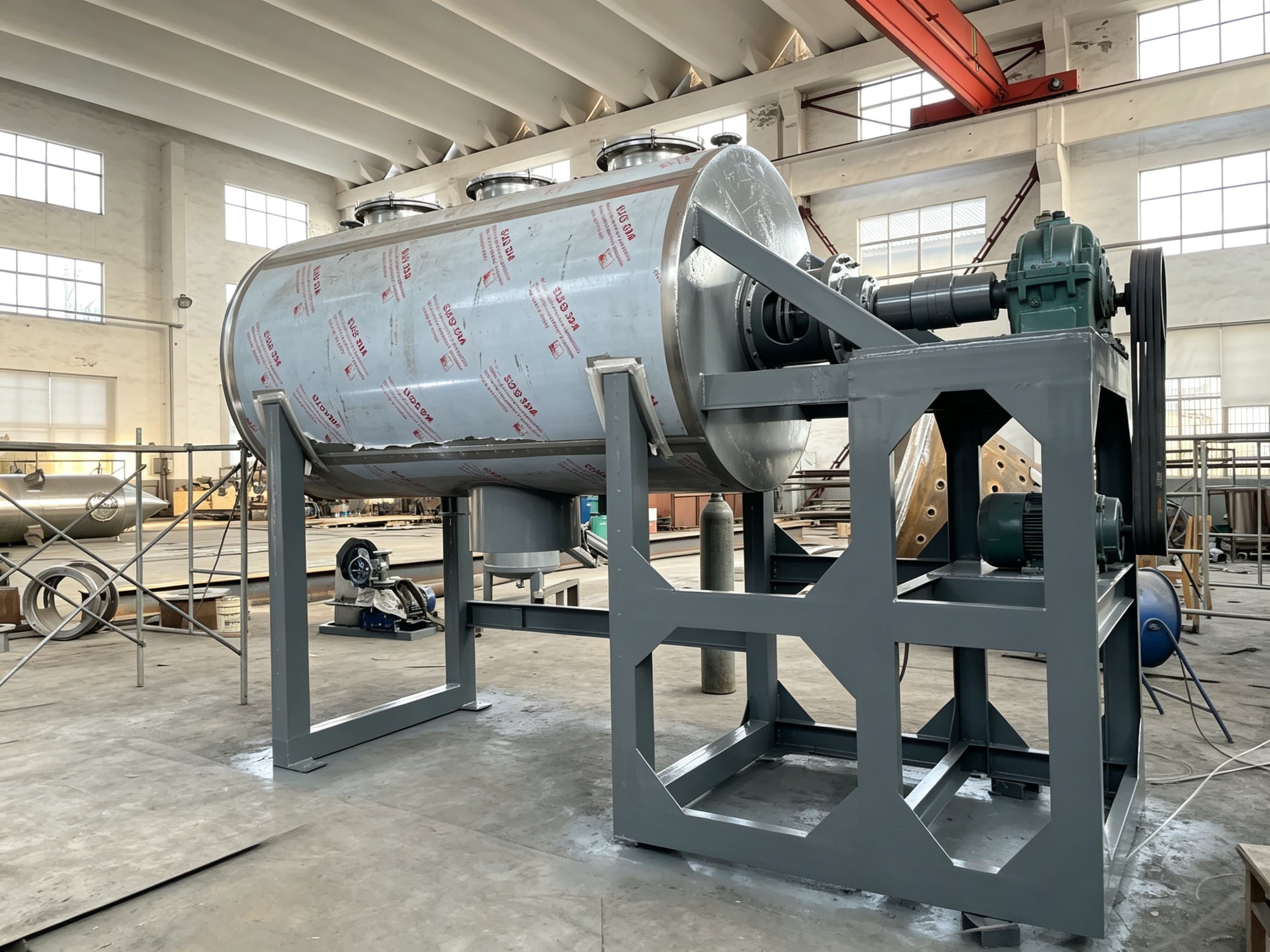
Why the Rake Keeps Sweeping the Wall
During drying the material at the wall dries first, and a dry layer conducts heat far more poorly than the wet bed behind it. Left undisturbed, that layer becomes an insulating crust, the heat-transfer rate falls, and the batch stalls in the final third of the cycle when the last moisture is hardest to remove. The scraper rake exists to prevent exactly that: it renews the contact surface continuously, which keeps the effective heat-transfer coefficient from collapsing as the product dries.
Agitation also homogenises the batch. Without movement the wall layer can overheat while the bulk is still wet, which is a genuine degradation risk for a thermally sensitive active. Circulating the bed keeps the whole batch close to one temperature and removes the local hot spots that a static dryer cannot avoid.
The same movement solves the material-handling problem that rules out other dryer types. A paste that will not tumble inside a rotating vessel, or a cake that would bridge in a tray, can be conveyed and folded by a rake. That is the main reason this geometry is quoted for filter cakes, sludges and paste-like intermediates rather than for free-flowing granules alone.
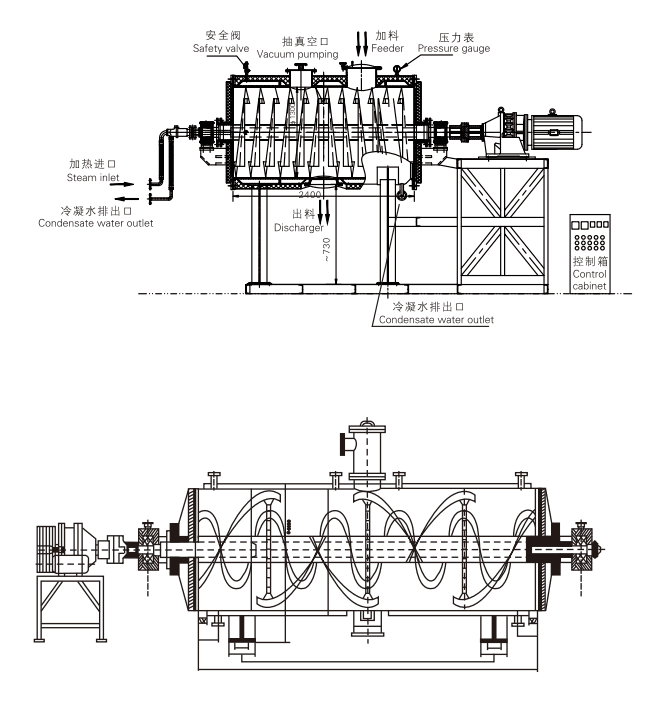
Six Inputs That Decide the Model
Sizing an agitated vacuum dryer starts from the material, not from a vessel volume. Six inputs drive the selection, and a supplier who does not ask for all six is estimating rather than sizing.
- Batch mass of wet feed in kilograms, set by the upstream process rather than by the dryer.
- Wet bulk density of the real cake or paste, measured on the actual material instead of read from a dry powder datasheet.
- Initial and final moisture, stated on the same basis, because mixing a wet basis with a dry basis is a routine source of undersized equipment.
- The liquid being removed, since a solvent brings its own latent heat, boiling curve, flammability class and recovery requirement.
- The permitted product temperature, which caps the jacket temperature and therefore the temperature difference available to drive heat into the bed.
- The target cycle time in hours, which is the constraint that most often makes a duty infeasible at the batch size requested.
Two Constraints Pull Against Each Other
The permitted product temperature and the required cycle time act in opposition. Shortening a cycle normally means a hotter jacket and a larger temperature difference, and a heat-sensitive product may not allow it. When those two numbers do not reconcile, the answer is usually more heat-transfer surface rather than more vacuum, because vacuum lowers the boiling point but does not add the latent heat the batch still needs.
For a feed that behaves unusually, a pilot batch on the customer material settles questions no datasheet can answer: whether the paste circulates at the intended fill level, whether it sticks to the wall, and what torque the agitator actually sees. Those are the three unknowns that turn a plausible specification into a working dryer.
The Standard Model Range
The ZPG series covers nine standard sizes, from ZPG-500 to ZPG-6000, with working volumes from 300 L to 3600 L and jacket heating areas from 3.2 m² to 16.5 m². Because the evaporation rate depends on the material and on the temperature difference the product permits, the series is specified on working volume and heated area rather than on a single quoted evaporation figure; the final number follows from the material test.
ZPG Vacuum Rake Dryer Standard Models
| Model | Working volume (L) | Heat transfer area (m²) | Stirring speed (rpm) | Power (kW) | Jacket design pressure (MPa) |
|---|---|---|---|---|---|
| ZPG-500 | 300 | 3.2 | 8-18 | 4 | 0.3 |
| ZPG-750 | 450 | 4.4 | 8-18 | 5.5 | 0.3 |
| ZPG-1000 | 600 | 5.1 | 8-18 | 5.5 | 0.3 |
| ZPG-1500 | 900 | 6.3 | 8-18 | 7.5 | 0.3 |
| ZPG-2000 | 1200 | 8.1 | 8-18 | 7.5 | 0.3 |
| ZPG-3000 | 1800 | 10.6 | 8-18 | 11 | 0.3 |
| ZPG-4000 | 2400 | 12.3 | 8-18 | 15 | 0.3 |
| ZPG-5000 | 3000 | 14.2 | 8-18 | 18.5 | 0.3 |
| ZPG-6000 | 3600 | 16.5 | 8-18 | 22 | 0.3 |
Cylinder pressure range across the series is -0.096 to 0.15 MPa. Water evaporation capacity varies with material properties and is subject to final design.
Read the table for the relationship rather than for the sizes alone. Heated area per unit of working volume falls as the models get larger, from about 1.07 m² per 100 L at ZPG-500 to about 0.46 m² per 100 L at ZPG-6000. That is the surface-to-volume constraint common to every conduction dryer. The practical reading is that the largest models suit bulkier and less heat-sensitive duties, while a tighter duty is often better matched to a mid-range size and a longer cycle. Units above 5 m³ use a half-pipe jacket to distribute the heating medium evenly across the larger shell.
Vacuum System, Condenser and Solvent Recovery
The vacuum system carries two duties that are frequently confused. Evacuation duty means pulling the vessel down to operating pressure at the start of each batch and holding it against in-leakage. Vapour handling duty means removing the vapour generated at the calculated evaporation rate without letting the pressure rise. A pump selected on evacuation alone will be undersized for the sustained vapour load, because these are different requirements.
The condenser is sized on the same peak evaporation rate, with a coolant temperature low enough to condense the vapour at the lowest pressure the pump reaches. Choosing the coolant against the actual condensing curve of the specific solvent, rather than against a generic figure, is what prevents a condenser that passes vapour straight through to the pump. A colder condenser also shifts duty to the refrigeration system rather than eliminating it.
Where the feed is solvent-wet, recovery is usually the reason the project exists. Vapour drawn from the vessel is condensed and returned to a receiver, which cuts raw material loss and reduces the volatile load on downstream abatement. It also makes the drying step part of the site solvent balance rather than a venting operation.
Seals, Explosion Protection and Compliance
The shaft seal decides how well a vacuum dryer holds its pressure over a service life. The ZPG series is offered with either a mechanical seal or a packing seal, and the choice trades sealing performance against maintenance interval: a mechanical seal holds vacuum better and needs less attention, while packing is simpler and more tolerant of a demanding duty cycle.
For solvent-wet or combustible solids, explosion protection is designed together with the process rather than added afterwards. Three requirements are worth settling early.
- Equipment for use in potentially explosive atmospheres falls under ATEX Directive 2014/34/EU in the European Union, and a vessel wetted with a flammable solvent makes its interior a classified zone, which shapes seal design, instrumentation and inerting.
- Where nitrogen inerting is used, the oxygen concentration inside the vessel is controlled and monitored, and the vacuum system has to handle the inert gas load as well as the vapour.
- Motor and electrical components can be specified in an explosion-proof configuration for hazardous powders, which is how the series is applied to combustible dusts and solvent-wet intermediates.
If the equipment is placed on the European market, the framework that will apply is Machinery Regulation (EU) 2023/1230, which replaces the earlier Machinery Directive and applies from 14 January 2027. Ask for conformity documentation against the regulation in force on the delivery date, and ask for pressure-part design calculations and material traceability rather than a general statement of compliance. Retrofitting certification onto a fabricated vessel costs far more than specifying it at the outset.
Where to Go Next
The working principle above holds for every agitated vacuum dryer, and two questions are worth settling before quotations are compared: which surfaces in the machine actually carry heat, and what heated area is being offered at the batch size you need. A quotation built on vessel volume alone leaves both open. If the duty is solvent-wet, size the condenser and vacuum system on the same evaporation rate you used for the jacket, and settle the explosion protection concept at the same time rather than after the order.
Frequently Asked Questions
- What is a rotary vacuum paddle dryer used for?
- It dries materials that are too heat-sensitive, too paste-like or too hazardous for a hot air dryer: pharmaceutical and chemical intermediates, pigment and dye pastes, chemical filter cakes, sludges, food extracts and battery precursor powders. The vacuum lowers the boiling point so the product dries cool, and the sealed vessel keeps oxygen away from oxidation-sensitive or combustible solids.
- Is a rotary vacuum paddle dryer the same as a vacuum rake dryer?
- Often the same search term describes different machines, so it is worth checking the drawing. In a rake or scraper design the jacket carries the heat and the agitator sweeps the wall. In a hollow blade or paddle design the blades themselves are heated, which adds heat-transfer surface inside the bed. Both are agitated conduction dryers, but they do not offer the same capacity at the same vessel volume.
- Can a rotary paddle dryer run continuously, or is it batch only?
- The horizontal vacuum rake design is a batch machine: charge, dry, discharge. Continuous drying of the same materials is normally handled by a hollow blade paddle dryer, which conveys material along the trough with the same blades that heat it. Which one fits depends on throughput and on whether the process can be organised into batches.
- What vacuum level does the process need?
- The ZPG series is rated to -0.096 MPa, which corresponds to an absolute pressure of roughly 5 kPa. How deep you actually run depends on the liquid: the goal is a boiling point low enough that the liquid leaves at a temperature the product tolerates. Running deeper than the product needs adds load to the vacuum system without improving the result.
- How do I work out what batch size a vacuum paddle dryer can take?
- Start from the wet batch mass and the wet bulk density to get the working volume, then check that the jacket area at that size can remove the liquid within your cycle time. A vessel large enough to hold the batch is not automatically large enough to dry it in the time available, and that gap is where most sizing errors begin.
- Will it handle a sticky paste that will not flow?
- This is the feed form the geometry suits best, because a rake can convey and fold material that would not tumble in a rotating vessel or bridge in a tray. Confirm it with a pilot batch on your own material: circulation at the intended fill level, wall sticking and the torque the agitator actually sees are all material-specific.
- What temperature does the product reach during drying?
- The product stays near the boiling point of the liquid at the operating pressure rather than at the jacket temperature. At roughly 5 kPa absolute, water boils near 34 °C, so a heat-sensitive material can be dried well below the temperature atmospheric drying would require. The jacket is still warm enough to supply the latent heat, but the product does not have to reach that temperature.