
A rotary paddle dryer handles paste and sludge by agitated conduction under vacuum or in a sealed trough. Which feeds fit, and how to size the duty.
A rotary paddle dryer dries paste and sludge by holding the material against a heated surface while an agitator keeps folding the bed so fresh material keeps reaching that surface. The duty runs either under vacuum in a sealed batch vessel or continuously through a sealed trough. What decides which design fits is the feed form and the plant around it, not the machine name.
Paste and sludge are the two feed forms that rule out hot air drying, and they are also the two where the design details away from the heating surface cause most of the operating trouble. This article covers what each feed form demands, how to characterise it, and how the arithmetic of water removal justifies the project.
What a Rotary Paddle Dryer Handles Best
Paste and sludge describe a handling problem rather than a chemistry. What these feeds share is that they arrive wet, thick and often non-flowing, so they cannot be dried by blowing hot air across them. A rotary paddle dryer solves that by putting the material in repeated contact with a heated surface and moving it so the contact keeps renewing itself.
The table below sets out what each feed form does in service and what the design has to provide in response. The distinctions matter, because they drive the choice of agitator, seal, discharge and vapour system.
Feed Forms and What They Demand
| Feed form | What it does in service | What the design must provide |
|---|---|---|
| Pumpable paste | Flows in and settles; it will not tumble on its own | Agitation that folds the bed rather than merely stirring it |
| Sticky filter cake | Compacts, and adheres to the hot wall | Continuous scraping of the heat-transfer surface |
| Dewatered sludge | Carries a large water load with little solids, and is often odorous | High evaporation capacity plus vapour containment and odour control |
| Free-flowing powder or granule | Moves easily, and generates dust | Gentle handling and a sealed path to limit dust |
Characterise the Feed Before You Specify a Design
Paste and sludge duties are usually lost on the properties that a product datasheet does not carry. Seven measurements decide the design, and the first is the one most often missing.
- Dry solids content of the as-received feed, together with the target dry solids after drying. The water load and the volume reduction both follow from these two numbers.
- Whether the liquid is water or a solvent, since a solvent brings its own latent heat, flammability class and recovery duty.
- Adhesion: whether the material sticks to a warm steel surface. This single property decides whether a scraper is essential or merely helpful.
- Abrasion: grit and mineral fines in sludge wear both the agitator and the wall, and they change the material of construction.
- Corrosion: pH, chloride content and the presence of halides decide whether a standard stainless grade is adequate or a higher alloy is required.
- Odour and volatile content, which drive vapour containment, scrubbing and the pressure class of the sealed system.
- How the feed is delivered, either continuously from an upstream filter, press or centrifuge, or in discrete charges.
Two of these deserve a pilot trial rather than an estimate. Adhesion and abrasion cannot be read off a specification sheet, and both determine whether the machine still performs in its third year rather than only in its first week.
Three Ways to Handle a Paste
Once the feed is characterised, the geometry usually falls out of the numbers. The rotary paddle dryer family covers most paste and sludge duties in three designs, and they differ in where the heat enters the material and in whether the duty can run continuously.
Agitated Designs for Paste and Sludge Duty
| Design | Where the heat enters | Agitator | Duty |
|---|---|---|---|
| Horizontal vacuum rake | Jacket wall | Scraper rake on a central shaft | Batch, under vacuum |
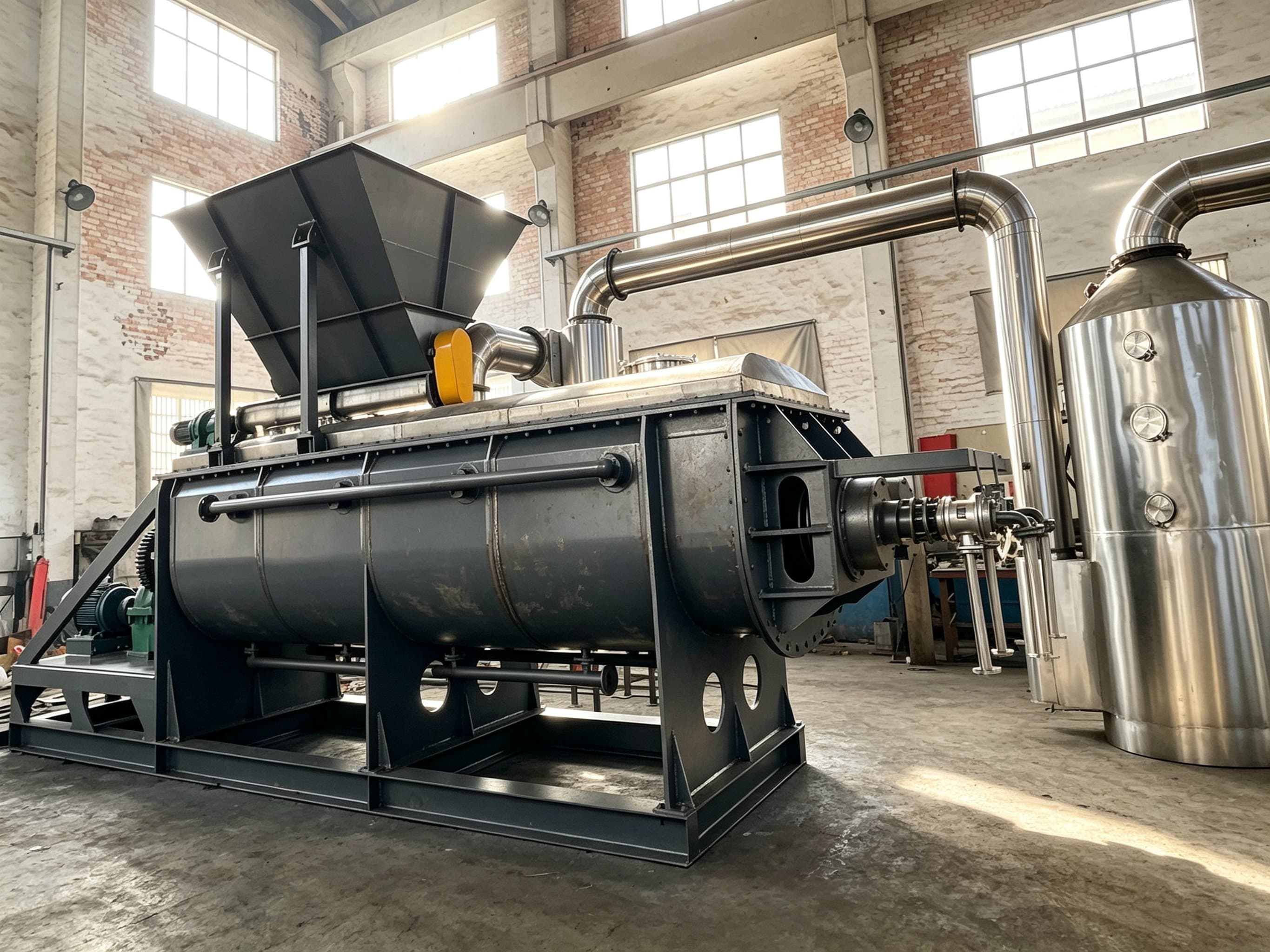
| Continuous hollow blade | Jacket plus heated wedge blades on hollow shafts | Two to four hollow shafts, self-cleaning | Continuous or batch, sealed trough |
| Vertical cone with heated ribbon | Jacket plus the internal ribbon | Ribbon lifts and cascades the bed | Batch, under vacuum |
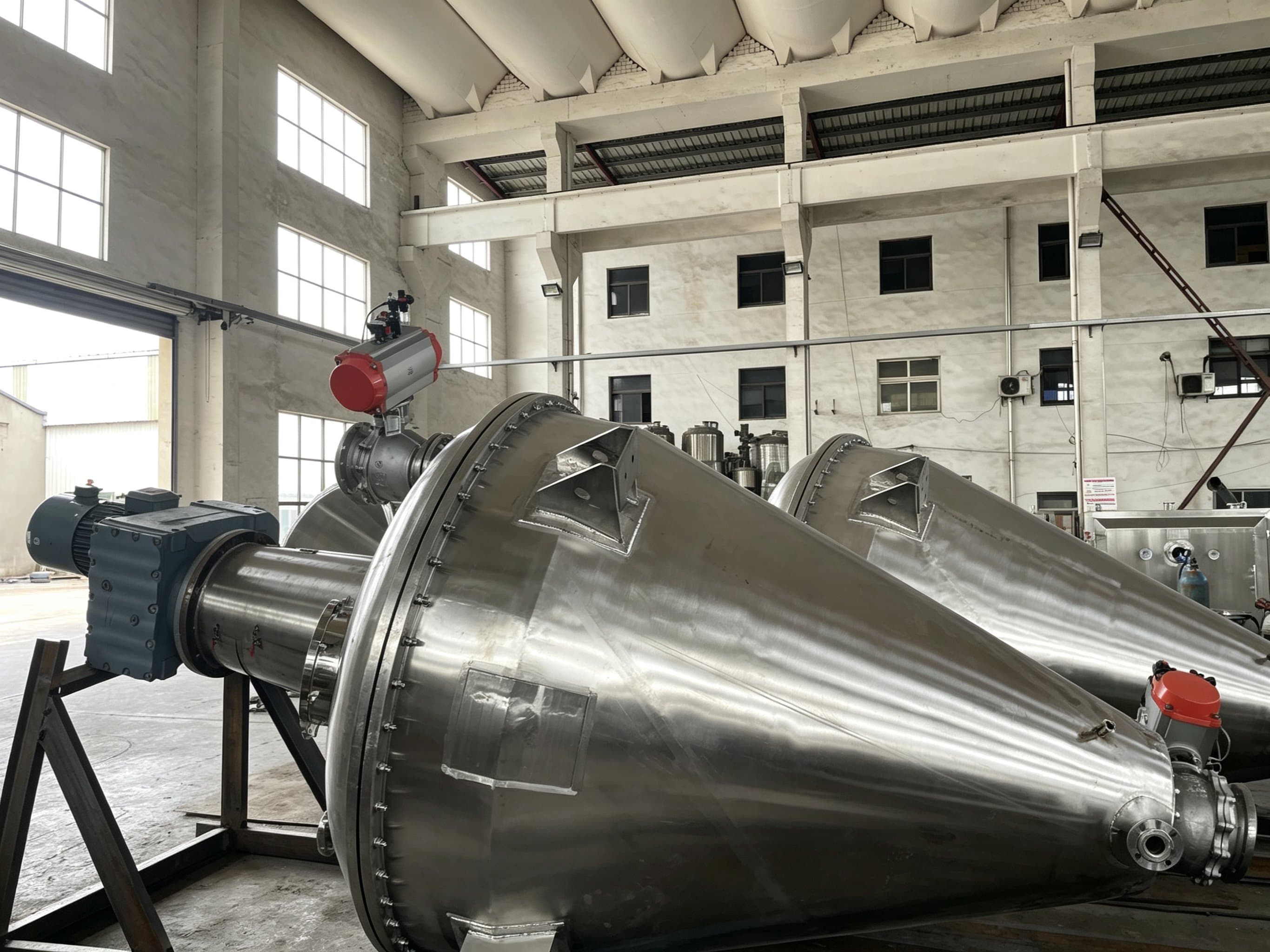
The horizontal vacuum rake design is the batch workhorse for a paste that has to be dried cool and cleanly. Its agitator does one job: it keeps the heated wall swept, which prevents the dry layer that would otherwise insulate the bed and stall the batch in its final third. It is the right answer when the batch is moderate, the product is heat-sensitive, and solvent recovery is part of the duty.
The continuous hollow blade design takes the same conduction principle and adds heated surface inside the bed by running heating medium through wedge-shaped blades mounted on hollow shafts. Heat medium temperature spans -40 °C to 320 °C, and the wedge geometry scrubs the heat-transfer surface clean as it turns. Because the body is a sealed trough with a weir-plate discharge gate, material can be conveyed through it continuously, which is what makes it the usual choice for sludge and filter cake volume reduction at scale.
The vertical cone with an internal ribbon serves a different purpose again. It combines drying with mixing, so a paste or resin that needs intensive blending while it dries can be finished in one vessel instead of two.
Volume Reduction: The Arithmetic That Justifies the Project
For sludge, the business case is arithmetic. Take 100 kg of dewatered sludge at 20 per cent dry solids. The dry mass is 20 kg. If the dryer takes the product to 90 per cent dry solids, the final mass is 20 divided by 0.9, which is 22.2 kg. The number that matters is the next one: the water removed is 77.8 kg, so the tonnage leaving site falls by roughly 78 per cent.
That reduction is what pays for the equipment. Haulage and disposal are charged per tonne of wet material, so removing water before transport cuts a cost that recurs monthly rather than once. The same arithmetic explains why a sludge duty is normally quoted on evaporation rate rather than on vessel volume: the rotary paddle dryer is a water-removal device, and its capacity is set by how much water it can boil off per hour.
The constraint is energy rather than volume. Removing water by evaporation always costs the latent heat, and indirect conduction designs are efficient about it: the KJG hollow blade series is quoted at approximately 1.22 kg of steam per kg of water evaporated, because heat is transferred through the wall rather than carried in a stream of hot air that then leaves warm. Even so, the honest comparison is not against doing nothing but against mechanical dewatering, which removes water far more cheaply. Drying earns its place at the end of the chain, after the press or centrifuge has taken the feed as far as it economically can.
Batch or Continuous, and What Each Demands
The choice between batch and continuous is usually settled by the equipment upstream and downstream of the dryer rather than by the dryer itself.
What Batch and Continuous Duty Each Require
| Consideration | Batch, horizontal vacuum rake | Continuous, hollow blade trough |
|---|---|---|
| Feed delivery | Discrete charges from a reactor or tray | A steady flow from a filter, press or centrifuge |
| Vacuum | Vessel sealed and evacuated for each charge | Sealed trough with vapour extraction; vacuum optional |
| Product changeover | Straightforward; the vessel empties completely | Needs purging, or a dedicated unit |
| Throughput at scale | Multiply the number of vessels | One larger machine carries the whole duty |
| Cycle or residence time | Set per batch against the material | Set by residence time and weir level |
| Usual fit | Heat-sensitive, solvent-wet, higher-value solids | High-tonnage sludge and filter cake |
The mistake to avoid is treating continuous as automatically better. A continuous machine needs a steady feed, so a plant that produces sludge intermittently will either run the rotary paddle dryer well below its design rate or buffer-store feed to keep it fed. A batch machine tolerates uneven supply and gives every charge its own residence time, which is why heat-sensitive and solvent-wet duties usually stay batch even as volumes grow.
Discharge, Odour and Containment
The parts of a paste and sludge duty that cause the most operating trouble are not the drying surface. They are discharge and containment.
- Discharge: a dried paste can bridge or hang up, so the outlet geometry and any agitator assistance matter more than the nominal size of the opening. A sealed discharge that releases product without breaking the vacuum environment keeps the cycle short.
- Odour and volatiles: sludge drying releases odorous vapour, so the vapour path is closed and routed to condensation, scrubbing or thermal treatment instead of being vented to the workplace.
- Dust: dried sludge and fine powders generate dust on discharge, and filter media at the vapour outlet keep fines out of the vacuum system and the condenser.
- Condensate: the water removed has to go somewhere, and the condensate from sludge is often loaded with volatiles, so it is normally routed to treatment rather than to drain.
On the machine side, these duties come back to sealing, because a shaft seal decides how well the vessel holds its pressure over a service life, and to a condenser sized on the peak evaporation rate rather than on an average.
Where to Go Next
The order that works is to characterise the feed, decide whether the plant can supply a steady stream, and only then pick a geometry. Pastes and sludges punish assumptions made from appearance, which is why a pilot batch on the actual material is worth more than another quotation. If the duty is a heat-sensitive paste with solvent, start from the batch vacuum rake design. If it is high-tonnage sludge or filter cake, compare it against the continuous hollow blade machine before committing.
Frequently Asked Questions
- What kind of sludge can a paddle dryer handle?
- Filter press cake, centrifuge cake and municipal or industrial sludges all dry well in an agitated conduction machine, provided the design accounts for the grit, chloride and odour that come with them. The limiting factors are usually abrasion and corrosion rather than water content, and both are settled by the agitator design and the material of construction.
- How much volume does drying remove from sludge?
- Take 100 kg of sludge at 20 per cent dry solids. The dry mass is 20 kg, so drying to 90 per cent dry solids leaves 20 divided by 0.9, or 22.2 kg, and removes 77.8 kg of water. That is a reduction of roughly 78 per cent by weight, and it is the saving that recurs on every tonne hauled away. The real figure depends on the feed and on the target dry solids you need.
- Can a rotary paddle dryer dry a paste that is mostly water?
- Yes, and a high water load is the normal case for a paste duty: it is the design driver, not the solids. The practical question is whether the heat-transfer area available can remove that water within a cycle time the plant can tolerate. When it cannot, the answer is usually more heated area or mechanical dewatering upstream, not more vacuum.
- Does paste or sludge need pre-treatment before drying?
- Not usually, but it is worth removing what the dryer cannot handle. Metal fragments and coarse grit damage the agitator, so a screen or trap upstream protects the machine, and free liquid that can be drained or pressed out first is cheaper to remove mechanically than by evaporation.
- Will abrasive sludge wear out the dryer?
- Abrasion is a real design condition for sludge, not an edge case. It is handled by specifying a harder or thicker wear surface and by keeping agitator speed low, and the same property usually decides that the wetted parts should not be a standard stainless grade. A pilot run with the actual feed is the reliable way to judge wear rate.
- What dry solids content can be reached?
- There is no single figure. The achievable dry solids depend on the material, on the jacket temperature the product tolerates, and on the cycle time the plant will accept. The honest way to fix a target is to determine it in a pilot test on the actual feed, rather than to adopt a number from a similar-sounding application.
- Is odour a problem when drying sludge?
- It is the main environmental issue in the duty, which is why the vapour path is closed throughout. Vapour drawn off the vessel is routed to a condenser and then to scrubbing or thermal treatment rather than vented, and the condensate is itself loaded with volatiles, so it normally goes to treatment instead of to drain.