
Application Note — Chemical
Continuous Plate Drying for a Solvent-Wet Chemical Powder
Solvent-wet granular chemical powder, free-flowing once dried
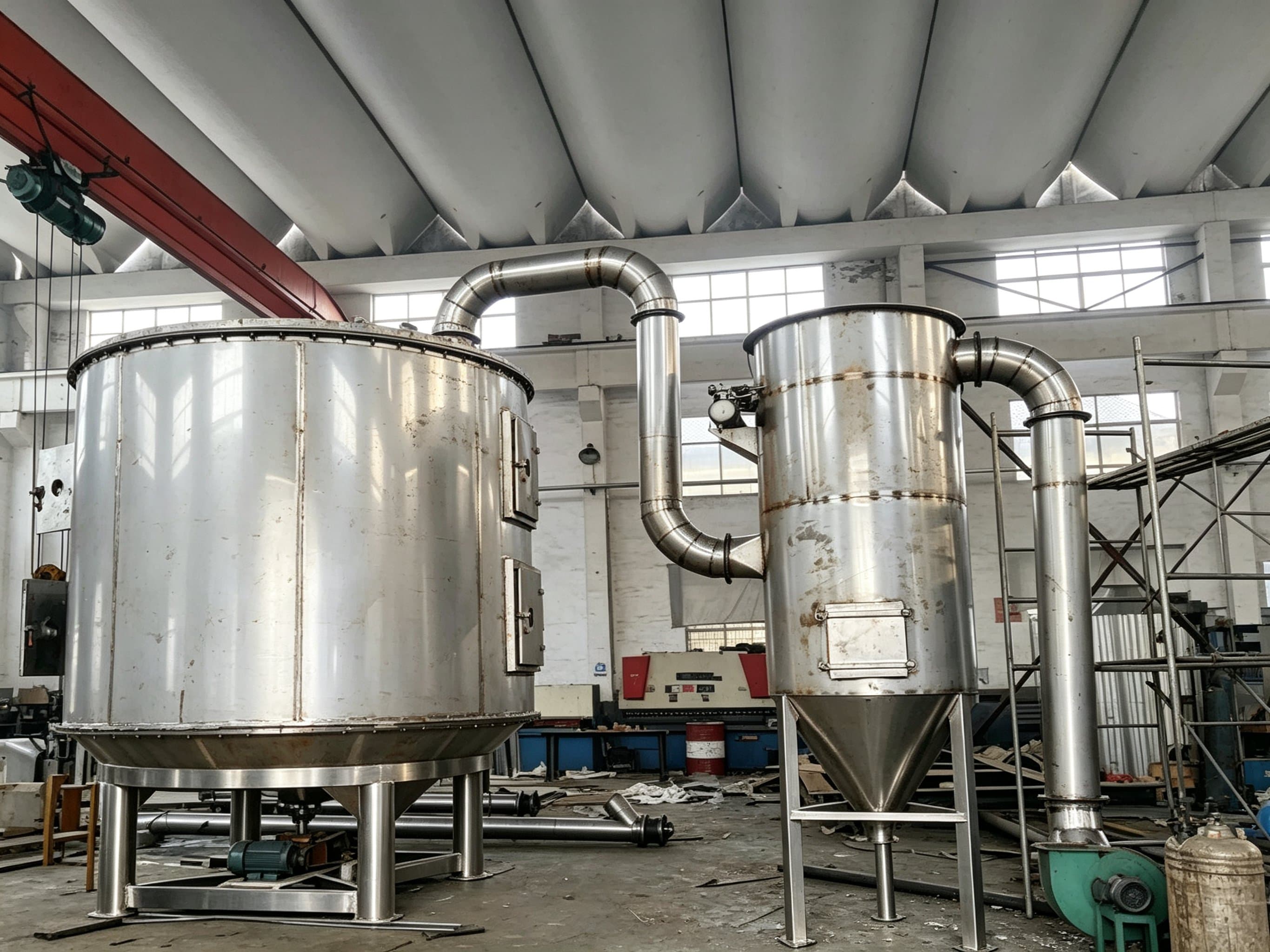
Prepared from Ruibo product data and typical operating conditions. It is not a specific customer project.
The Challenge
Granular chemical powder leaves the centrifuge wet with solvent, and the moisture has to come off without pushing the product past its temperature limit. A single-zone tray oven cannot do both jobs. The trays nearest the heat source dry first and keep taking heat while the rest of the batch is still wet, so one batch ends up over-dried and under-dried at the same time. Operators compensate by extending the cycle, which lengthens thermal exposure for the whole batch and raises the solvent load in the exhaust. Solvent recovery adds a second constraint: the drying chamber has to stay closed and the vapour has to leave through one controlled outlet instead of an open door.
The Solution
The PLG continuous plate dryer meets both requirements with one mechanical design. Wet powder is fed onto the top drying plate and turned in an exponential spiral across each plate by rotating rake arms, then drops through the central opening to the plate below. Material moves in a single direction with no back-mixing, so dried product never re-enters the wet feed and every particle follows the same path. Each hollow plate receives its own heating medium: the first plates can run on hot water below 100 °C while the finishing plates take steam at 100-150 °C to drive off the residual moisture. Plate pressure is generally ≤0.4 MPa, with spindle speed of 1-10 rpm and 2-8 rake arms per plate. In the closed configuration the solvent vapour leaves through the top vent to a condenser rather than to the room. Drying area spans 4 to 180 m² across three configuration types, so capacity is matched by plate area instead of by a longer cycle.
Project Process
- Feed the wet powder continuously onto the first drying plate at the top of the dryer, so the bed depth on each plate stays constant
- Rotating rake arms turn the bed in an exponential spiral across every plate, so each particle meets the heated plate surface
- Material drops through the central opening to the next plate, moving in one direction through the dryer with no back-mixing
- Give each plate its own heating medium — hot water below 100 °C on the first plates, steam at 100-150 °C on the finishing plates — to shape the drying profile
- In the closed configuration, route the solvent vapour from the top vent to a condenser and recover the solvent
- Dried powder falls from the last plate to the shell bottom and is discharged continuously by the rake blades