
Conduction and convection move heat into a wet solid in different ways. This guide shows how to tell which mode your material and plant can support.
Two routes for the same heat
Every dryer answers one question: how does heat reach the water that has to leave? In industrial drying there are only two answers. Either heat crosses a wall that the material touches, or heat arrives in a gas that the material meets. Almost every machine on the market is a variation on one of these two.
The choice is not a matter of preference. It decides what the equipment can do with your material, how the vapour is handled, and which numbers a supplier has to ask you for before a quotation means anything.
Conduction drying: heat through a surface
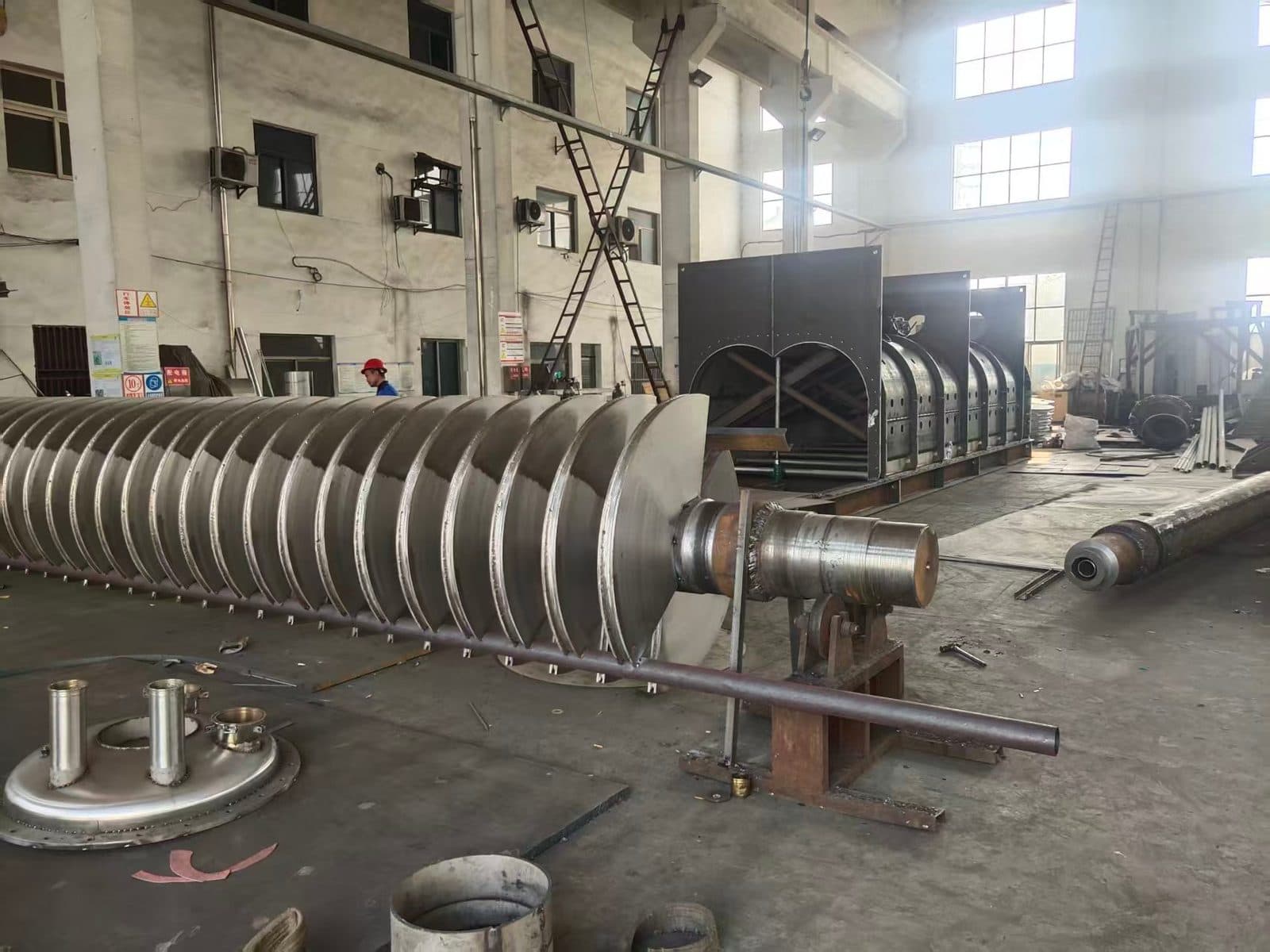
In a conduction dryer the heat medium never touches the product. Steam, hot water or thermal oil circulates inside a jacket, a plate, a drum or a hollow shaft, and heat crosses a metal wall into the material lying against it. The KJG hollow blade dryer is the clearest example: the medium flows through the hollow shaft into wedge-shaped blades, and the blade surface itself is the heat transfer area.
Because nothing has to be heated except the product, the exhaust volume stays small. That matters twice. Dust entrainment is limited, and a solvent-laden vapour leaves in a concentrated stream that is worth condensing rather than venting.
The wall has to stay clean, which is the real engineering problem in this family. On the KJG the wedge blades compress and expand the bed as they turn, so the heat surface is scrubbed by the material itself instead of fouling into an insulating layer.
- Heat transfer area is the design currency, not air volume: on the KJG the effective area per unit volume is what shortens the cycle.
- The heat medium range spans -40 °C to 320 °C, so one body can dry, heat, cool, or run a low-temperature calcination step.
- Indirect heating needs roughly 1.22 kg of steam per kg of water evaporated on the KJG, because heat is not carried away in a large exhaust stream.
- Pastes, filter cakes and granules are all workable, provided the agitator keeps the surface in contact with fresh material.
Convection drying: heat carried by gas
A convection dryer heats a gas and puts it in contact with the material. Hot air does two jobs at once: it delivers heat and it carries the vapour away. The ZLG vibrating fluidized bed dryer works this way, with hot air passing up through the bed plate, lifting the particles, and leaving with the moisture.
Convection is the right answer when the material is a powder or a granule that can be suspended, and when the plant wants a continuous line rather than a batch. It is also the mode that can cool in the same pass: the ZLG carries material from a drying zone into a cooling zone before discharge, so the product leaves at a packaging-safe temperature.
The trade is volume. The gas that removes the moisture has to be cleaned, and whatever it carries out of the bed has to be recovered. Cyclones and filters are part of the design, not an accessory bolted on afterwards.
- Air volume sets the size: bed area and fan power follow from how much air the duty needs.
- The gas becomes part of the process, so inlet humidity, temperature and cleanliness all change the result.
- Continuous flow suits one product run for a long time; changing product means changing the line settings.
- Fine powders leave with the exhaust unless the system recovers them.
Where the two modes actually differ
The table below is the set of questions that separates the two modes in a real quotation. None of them is about efficiency in the abstract. Each one changes the machine you have to buy, the utilities you have to provide, and the permits you may need.
Conduction and convection compared
| Design question | Conduction (indirect) | Convection (direct) |
|---|---|---|
| Heat path | Through a jacketed wall, plate, drum or hollow blade that the material touches | Through hot gas in direct contact with the material |
| Exhaust volume | Small; vapour leaves concentrated | Large; the gas stream carries the vapour |
| Dust and entrainment | Limited by sealed covers and low gas flow | Carried by the gas; recovery equipment is required |
| Solvent handling | Closed loop with a condenser on the vapour line | The gas loop has to be closed and inerted |
| Temperature control | Set by the heat medium; -40 °C to 320 °C on the KJG | Set by inlet air temperature and flow |
| Product form | Paste, filter cake, granule, powder | Powder or granule that can be fluidized |
| Typical duty | Batch or continuous indirect drying, cooling, reaction | Continuous drying and cooling in one pass |
Ranges quoted are from the published product data for the models named.
Matching the mode to the material
Start from the material, not from the machine. The classes below are the ones the two families are actually built for, taken from the product data rather than from a general rule.
- Sludge and filter cake: conduction, because the material is a paste that would blind a gas path. The KJG and the ZPG vacuum rake dryer both handle it, and vacuum adds a lower boiling point when the cake is heat-sensitive.
- Chemical powders and granules on a continuous line: convection in a vibrating fluid bed, or conduction across stacked plates when the product must not see a large air volume. The PLG continuous plate dryer rakes material across heated plates with temperature zoning per plate.
- Solutions, emulsions and suspensions: neither. That feed has to be atomised first, which is what the LPG centrifugal spray dryer does in a single pass.
- Heat-sensitive solids: conduction under vacuum, as on the SZG conical vacuum dryer or the ZPG rake dryer, because the product temperature is set by the wall rather than by a gas stream.
- Viscous material that must be dried in seconds: a drum surface, as on the HG single drum dryer, where the film is 0.3-1.5 mm and the residence time is 10-300 seconds.
Choosing the mode from the duty
| Duty or material behaviour | Mode that fits | Dryer family on this site |
|---|---|---|
| Wet paste or filter cake, not free-flowing | Conduction | Vacuum rake or hollow-blade dryer |
| Free-flowing granules needing gentle heat | Conduction | Conical vacuum or plate dryer |
| Slurry that must become powder in seconds | Convection | Centrifugal spray dryer |
| Heat-sensitive powder with a tight moisture spread | Convection at low gas temperature | Vibrating fluidized bed dryer |
| Solvent-wet material with recovery requirement | Conduction under vacuum | Vacuum rake dryer with condenser |
Source: Ruibo product range. Confirm the mode with a drying test before sizing.
What the quotation has to answer
Two dryers with the same nominal size can differ by a wide margin in throughput, so the specification has to be written from measurements. Before either mode can be priced, a supplier needs the initial and final moisture with the basis stated, the batch mass or the continuous feed rate, the maximum product temperature, and the liquid being removed.
If the answer is that nobody is sure, a drying test on the real material settles it faster than any comparison table. The same test shows whether the material stays friable or smears across the hot surface, and that observation is what decides between a rake, a ribbon and a hollow blade in the first place.
Questions engineers ask before choosing
- Is conduction drying always more efficient than convection?
- No. Conduction avoids heating a large gas stream, and on the KJG that shows up as roughly 1.22 kg of steam per kg of water evaporated. But convection can use recovered heat and can dry a heat-sensitive powder at a lower surface temperature. The comparison only means something once the duty is fixed.
- Can a convection dryer handle a paste?
- Not directly. A paste has to be granulated or pre-dried before it can be fluidized. Pastes and filter cakes belong in a conduction machine with an agitator that keeps the heat surface clear.
- Which mode is better for solvent-wet material?
- Conduction is the simpler closed loop: a small vapour stream goes to a condenser and there is little gas to inert. A convection system can be built for solvent duty, but the whole gas loop has to be closed and inerted.
- Does the heat medium decide the mode?
- It constrains it rather than decides it. Steam, hot water and thermal oil all work in a conduction dryer across -40 °C to 320 °C. A convection dryer is limited by what the inlet air can carry without damaging the product.